
Nursing Program Helps Address Nationwide Shortage
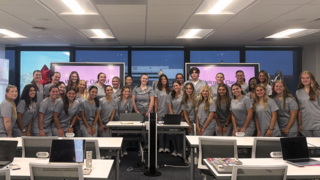
In 2024, Hawk Hill welcomed its first nursing cohort, preparing graduates to strengthen regional healthcare.
The demand for healthcare in the United States is accelerating. As the population ages, life expectancy rises and chronic diseases become more common, the need for skilled professionals is greater than ever.
By 2030, one in five Americans will be over 65, increasing the demand for nurses on the front lines of healthcare. According to the Bureau of Labor Statistics, roughly 189,000 registered nurse positions will open each year over the next decade to keep pace with this demand.
Saint Joseph’s University is playing a critical role in meeting this need, having welcomed its first class of nursing students on Hawk Hill last fall. The program complements the University’s established nursing program in Lancaster and expands Saint Joseph’s growing portfolio of healthcare offerings across the region.
Hawk Hill’s first-year nursing students began with general education courses, reflecting Saint Joseph’s Jesuit identity and liberal arts tradition. Now in their second year, the students are moving into advanced nursing and clinical coursework. Through an agreement with the Philadelphia College of Osteopathic Medicine (PCOM), students are gaining unparalleled access to advanced simulation and lab experience.
They are already showing the grit and resilience that we love to see in future nurses.
Melanie Rodriguez, MSN, RN, CPEN, CNE
Nursing Program DirectorCross-department collaboration further enriches the student experience. Through the Institute for Clinical Bioethics’ health promoter program, Hawk Hill nursing students are introduced to service opportunities that address health disparities and inequities across the Philadelphia region. For example, the cohort recently assisted with health screenings at the Guatemalan Consulate, where they conducted blood pressure readings, glucose monitoring and cholesterol assessments. Meanwhile, clinical rotations with partners such as Main Line Health and Penn Medicine offer students direct experience in both large hospital systems and community-focused care.
“We want our students to go out into the profession and be prepared to face whatever challenges come their way,” says Melissa Snyder, DEd, FNP, CNE, dean of the School of Nursing and Allied Health. “We want them to enjoy their work, be committed to it and provide care for decades to come.”
Hawk Hill nursing program director Melanie Rodriguez, MSN, RN, CPEN, CNE, agrees.
“These experiences are invaluable,” she adds. They allow students to see a full spectrum of patient care and prepare them to meet the diverse needs of the communities they will serve.”
Rodriguez is confident that Saint Joseph’s nursing students will do more than just help address the shortage.
“Instructors often describe our students as the ‘best students they’ve ever had’ – respectful, kind and eager to learn,” says Rodriguez. “They are already showing the grit and resilience that we love to see in future nurses.”