Living the Mission

Built by Women, Designed for All

The Alumnae Center for Leadership reaffirms the University’s commitment to personal and professional development.

Four female panelists and abc's Tamala Edwards at the Lead On event Student and alumna panelists at the University’s “Lead ON: A Celebration of Alumnae Leadership” event on Thursday, Nov. 6, 2025.

Published:

Total reading time: 1 minute

At 55%, Hawk alumnae constitute a majority of Saint Joseph’s University’s more than 100,000 living alumni. These women hail from a wide spectrum of industries, hold esteemed leadership roles, pioneer major advancements, and contribute to their communities in transformative and lasting ways.

To harness this powerful network and expand and unite the University’s existing programming and mission, Saint Joseph’s is now strategically broadening the reach of its Women’s Center to become the new SJU Alumnae Center for Leadership. Built by women, but designed for all, the Alumnae Center — which was officially announced at the University’s “Lead ON: A Celebration of Alumnae Leadership” event on Thursday, Nov. 6, 2025 — will support students and graduates alike to grow as leaders in their careers, communities and beyond.

Alumna Mary Lou Quinlan, BA ’75, H ’07, has long been a catalyst for leadership and empowerment initiatives at SJU. Now, she has volunteered to serve as the Center’s director for its inaugural 2025-2026 year and has made a five-year pledge to support initial programming. Her vision for the establishment of the Alumnae Center is really about making connections and a space for leaders to flourish.

Learn more about the Alumnae Center for Leadership in 21 Questions with Mary Lou Quinlan, BA ’75, H ’07.

Living the Mission

Cultivating Health Careers in Camden

Saint Joseph’s is working to demystify health careers for Camden City School District students through an annual Health Careers Fair.

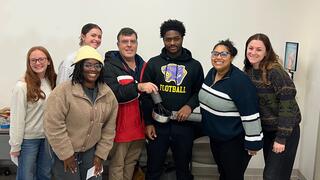
A group of students posed in an OT simulation space Camden High Schoolers get familiar with tools in the occupational therapy lab at Saint Joseph's University

Written by: Emmalee Eckstein

Published:

Total reading time: 2 minutes

According to a study in the International Journal for Medical Education, opportunities for high school students to conduct research or shadow medical professionals are limited. However, exposure to these professions in adolescence can increase teens’ interest in healthcare careers and ultimately their pursuit of medical education.

Starting in 2023, Saint Joseph’s University’s School of Health Professions (SHP) began partnering with South Jersey Solutions to expose Camden City School District students to health careers through a Health Careers Fair.

The event is held annually for students in grades 9–12 from Camden High School and Eastside High School. SHP faculty gather groups of students to share valuable insights on educational pathways and job outlooks within their respective fields, enhancing students’ understanding of available opportunities. Students then participate in hands-on activities at interactive stations, demonstrating real-world applications from each health profession.

“This is a really impactful way for us to introduce and expose potential students to these much-needed professions,” reflects Sarah Corcoran, OTD, OTR/L, clinical assistant professor of occupational therapy, who spearheads this project every year. “What we’re really excited about now is deepening this connection we’ve made by inviting these students to join us on campus.”

In November 2025, Corcoran worked with South Jersey Solutions, the school district and her colleagues to expand the Health Careers Fair and bring these same high schoolers to St. Joe’s for a day-long immersive health-education experience.

This is a really impactful way for us to introduce and expose potential students to these much needed professions.

Sarah Corcoran, OTD, OTR/L

Clinical Associate Professor of Occupational Therapy

Students were treated to tours of Saint Joseph’s labs in University City, presentations from key student support and academic offices, a quick introduction to navigating financial aid and scholarships, and a networking lunch with current health-professions cohorts.

One of the most popular aspects of the day was the classroom visits where high schoolers heard from current students in physical therapy, occupational therapy, exercise physiology, pharmacy and physician assistant studies about their paths and what surprised them about their current majors. 

“This was such a rewarding day,” notes Billy Scott, BS ’25, DPT ’27. “I was able to connect with some of the students who have had personal experiences with physical therapy, as well as those who were just curious to learn more about it. Seeing them get excited about PT got me excited about PT all over again.”

Living the Mission

Students Bring Healing to the Streets of Kensington

Through the Institute of Clinical Bioethics, students are delivering lifesaving care; collecting data to support Philadelphia’s opioid response; and gaining hands-on experience that is propelling them to top medical, physician assistant and nursing schools.
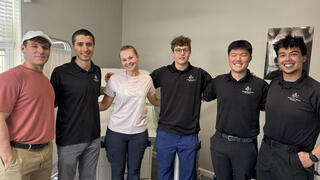
Six students smile at the camera with their arms around each other. Institute of Clinical Bioethics fellows inside the wound care clinic in Mother of Mercy House. Left to right: Santino Diana, BS ’26; Fredy Abboud, BS ’26; Emma Anderson, BS ’26; Benjamin Gabrieliants, BS ’26; Andren Chen, BS ’26; Ean Hudak, BS ’26

Written by: Kevin Gfeller

Published:

Total reading time: 4 minutes

Down Allegheny Avenue in Kensington, a small group of Saint Joseph’s University students pulls a wagon loaded with medical supplies through the heart of Philadelphia’s opioid epidemic. These fellows from the Institute of Clinical Bioethics (ICB) are taking the University’s Jesuit mission of service to the streets.

Each week, they arrive not with judgment, but with compassion, caring for individuals battling life-threatening substance use disorders. Their wagon is stocked with Narcan, gauze, saline, antiseptics and other essentials, serving as a mobile wound care unit. 

Many individuals inject fentanyl combined with veterinary tranquilizers, like xylazine or medetomidine, a dangerous mix that often causes severe wounds at injection sites and across the body. Left untreated, these injuries can lead to devastating complications, including amputation. 

The need is urgent and mobile wound care is just one aspect of ICB’s health promoter clinic in Kensington. In partnership with Mother of Mercy House, a faith-based organization supporting people experiencing homelessness, the ICB has also provided in-house wound care for nearly two years. Additionally, fellows offer free health screenings, food, eyeglasses, vitamins and more. 

This work is not for the faint of heart, but for those with the largest hearts. As the crisis continues to devastate the community, ICB has expanded its efforts. In March, the Institute opened an expanded wound care clinic inside Mother of Mercy House, offering services every Tuesday and Thursday to anyone in need. 

“The trust factor has increased,” says Peter Clark, S.J., PhD, professor of theology and religious studies and director of Saint Joseph’s Institute of Clinical Bioethics. “Since our expansion, we have seen more patients trusting our fellows because they see their faces more frequently. I think the issue is going to be the next step, which is getting them into the hospital or getting them into some type of rehabilitation center.” 

Taking that step from seeking help to entering recovery can be a giant leap. Ean Hudak, BS ’26, an ICB fellow, has seen this struggle firsthand.

“One guy approached us and said, ‘I’m ready to go. These wounds are getting to me,’” says Hudak. “Dianne Hoffmann, the executive director of Mother of Mercy House, found him a bed in a [treatment] facility in New Jersey. Meanwhile, a woman approached us who desperately needed surgery. We got a car to drive her over to a local hospital. But, she left before doctors recommended her discharge.”

I don’t think there is another college in the country running a wound care center in the middle of an opioid epicenter like Kensington. We’re not only serving people in crisis. We are adding to the science and helping the city respond.

Peter Clark, S.J., PhD

Professor of Theology and Religious Studies, Director of the Institute of Clinical Bioethics

Beyond direct care, the students are contributing to citywide research efforts aimed at understanding and treating xylazine-related wounds. Earlier this year, Temple, Penn and Jefferson University health systems jointly developed the first standardized staging system for these wounds. The staging system divides wounds into three categories: Stage 1 to Stage 3B, depending on the depth and severity of the wounds. 

The Institute has since adopted that framework and is now collecting data aligned with it, tracking patient demographics, health history, wound characteristics and drug use patterns. That information, analyzed by ICB fellows in collaboration with a University biostatistician, will be submitted to the City of Philadelphia by the end of 2025. The findings are expected to help local health agencies better understand emerging drug trends, like the rise of medetomidine, a veterinary tranquilizer increasingly appearing in the Kensington drug supply.

“I don’t think there is another college in the country running a wound care center in the middle of an opioid epicenter like Kensington,” says Clark. “We’re not only serving people in crisis. We are adding to the science and helping the city respond.” 

The one-of-a-kind work has proven transformative for Saint Joseph’s students. Fellows gain hands-on experience that few undergraduates ever encounter, helping them earn admission to leading medical, physician assistant and nursing programs. Hudak was accepted into Thomas Jefferson University’s Accelerated BSN Plus program within 24 hours of applying. Other ICB fellows have earned interviews and offers from Georgetown, Loyola Chicago, Temple and Einstein Medical College. 

“Explaining my experience with the ICB shows interviewers who we really are,” says Hudak. “When I tell them stories about the people we serve, they are moved by the compassion and practical care we provide. They see this is what medicine is all about.” 


Read more in The Philadelphia Inquirer's feature story, "Inside a Kensington wound care clinic."

Living the Mission

Faculty Receive National Institutes of Health Grant to Develop Therapeutics for Aggressive Breast Cancer

The research in the Department of Pharmaceutical Sciences seeks to identify novel targets for triple-negative breast cancer. 

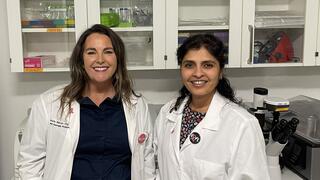
Two female faculty in white lab coats in a science lab

Written by: Madeline Marriott, MA ’26

Published:

Total reading time: 3 minutes

In September, an interdisciplinary team of Saint Joseph’s University researchers received a $420,600 R15 grant from the National Institutes of Health’s (NIH) National Cancer Institute to continue studying triple-negative breast cancer (TNBC), a notoriously aggressive form of the disease, which is difficult to treat. 

The R15 project combines the neurobiological approach of Asha Suryanarayanan, PhD, FPGEC, professor of physician assistant studies, with the cancer biology research expertise of Isabelle Mercier, PhD, professor and chair of the Department of Pharmaceutical Sciences.

Suryanarayanan’s research centers on ion channels, which are proteins on the cell membranes. In particular, the neuropharmacologist is focused on an ion channel known as Gamma-aminobutyric acid type A (GABAA) receptors, which are crucial for brain function. The collaboration with Mercier began when Suryanarayanan’s group noticed high levels of GABAA receptors in triple-negative breast cancer cells.

The strongest studies and discoveries come from merging different angles of thinking about the same problem.

Isabelle Mercier, PhD

Associate Professor and Chair of the Department of Pharmaceutical Sciences

"We started asking what these receptors are doing in these cells to decipher their role in breast cancer,” Suryanarayanan says. “We’re looking at if these cells can become less invasive if we treat the receptors with blocking agents or just decrease their expression in TNBC cells.” 

TNBC is difficult to treat, as the cancer cells test negative for estrogen, progesterone and HER2 receptors, meaning they will not respond to hormone therapy or other drugs that target those receptors.

“We identify targets that are expressed in TNBC and design therapies that go after what makes the cell grow fast and aggressively,” Mercier explains. 

The team has been working together on the research since 2021 and previously received funding from the Pennsylvania Department of Health. 

Mercier also received NIH funding in 2022 for TNBC research that explores the effect of a protein called CAPER (RBM39) in cancerous cells. Though both projects focus on TNBC, Mercier’s earlier NIH-funded project explores what happens on the nuclear level, or inside the cancer cell, while the R15 project focuses on the cell membrane. 

The multidisciplinary approach allows for outside-the-box thinking and innovative solutions to a longstanding problem, according to Mercier. 

“Interdisciplinary research is always stronger,” Mercier says. “We can’t just be in our lab doing our own thing by ourselves. The strongest studies and discoveries come from merging different angles of thinking about the same problem.”

The NIH grant allows undergraduate students to join the research team, as well. 

“It’s high-caliber, peer-reviewed research,” Mercier says. “The students are exposed to skills and concepts that would be impossible to provide without monetary support from the NIH. At conferences and in interviews, our students stand out because of their understanding of those high-level skills that come with doing this type of work.” 

According to Suryanarayanan, the project also exposes the students to the type of critical thinking that will be valuable in the workplace.

“All future projects are going to be interdisciplinary, whether it’s further research in graduate school or drug development as a scientist,” she says. “Their greatest strength moving forward will be their dual experience in neuroscience and cancer research, which equips them to view scientific questions through multiple lenses.”

Living the Mission

New Grant to Deepen Relationship Between Saint Joseph’s and State Correctional Institution – Chester

The Mellon Foundation subgrant will provide more opportunities for courses, faculty training and workshops.

A view of a building through a chain link fence.

Written by: A.J. Litchfield

Published:

Total reading time: 3 minutes

Invoking a famous speech delivered by Rev. Peter-Hans Kolvenbach, the former Superior General of the Jesuits, Professor Ann E. Green, PhD, says Jesuit institutions of higher learning have a responsibility to expose students to “the actual world as it unjustly exists.”

A grant from the Andrew W. Mellon Foundation, newly awarded through the Pennsylvania Consortium for Higher Education in Prisons (PA CHEP), will help Green and her colleagues do that important work by deepening the relationship between Saint Joseph’s University and State Correctional Institution – Chester. 

Since 2007, Saint Joseph’s has partnered with the Inside-Out Prison Exchange program, an initiative that brings students inside local jails and prisons to learn alongside people experiencing incarceration. Green explains that everybody takes the same class and completes the same coursework to foster dialogue across social differences. 

The goal of these immersive service-learning courses is, as Green describes, for both groups to come away with a better sense of empathy for one another. Additionally, Saint Joseph’s students attain a deeper understanding of what mass incarceration looks like from inside the prison rather than outside. 

“I learned about restorative justice through a lens of compassion and understanding,” says Faith Adedokun, BS ’27. “Taking that course made me more than a better student; it made me a better member of my community.”

“I sincerely hope that more incarcerated individuals are given the opportunity to experience this course,” says Ty, who enrolled in the class while incarcerated at SCI Chester. “I felt as if I had a voice. People looked past the colors I wore and actually wanted to hear what I had to say. I felt human again.”

Taking that course made me more than a better student; it made me a better member of my community.

Faith Adedokun, BS ’27

Now, Green and her colleagues are looking to broaden this impact. 

In addition to offering three credit-bearing courses, the recently awarded grant will allow Saint Joseph’s to further faculty development, both through training provided by Inside-Out and a new partnership with Greater Freedom Think Tank, a collective of incarcerated and unincarcerated educators and scholars. 

Saint Joseph’s will also now be able to play a bigger role in preparing those incarcerated at SCI Chester to reenter society. 

“Reentry,” says Green, “begins the first day you step foot in a prison. And one of the ways that you get ready to reenter is through education.” 

Green says that workshops on writing and communication, entrepreneurship, and financial literacy will help provide a sense of what to expect: What pathways are open to them? What skills are necessary? Will they pursue further education? 

Coming home can be overwhelming, but Green and her colleagues believe these workshops will make that transition easier. 

“It's our mission to be out in the world, and to bring the world into our campus,” Green explains. 

Doing so deepens students’ understanding and creates an avenue for them to do the emotional work of encountering someone different from themselves.