
Faculty Receive National Institutes of Health Grant to Develop Therapeutics for Aggressive Breast Cancer
The research in the Department of Pharmaceutical Sciences seeks to identify novel targets for triple-negative breast cancer.
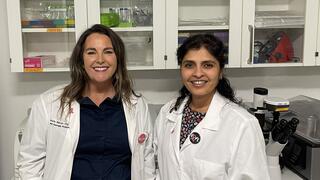
In September, an interdisciplinary team of Saint Joseph’s University researchers received a $420,600 R15 grant from the National Institutes of Health’s (NIH) National Cancer Institute to continue studying triple-negative breast cancer (TNBC), a notoriously aggressive form of the disease, which is difficult to treat.
The R15 project combines the neurobiological approach of Asha Suryanarayanan, PhD, FPGEC, professor of physician assistant studies, with the cancer biology research expertise of Isabelle Mercier, PhD, professor and chair of the Department of Pharmaceutical Sciences.
Suryanarayanan’s research centers on ion channels, which are proteins on the cell membranes. In particular, the neuropharmacologist is focused on an ion channel known as Gamma-aminobutyric acid type A (GABAA) receptors, which are crucial for brain function. The collaboration with Mercier began when Suryanarayanan’s group noticed high levels of GABAA receptors in triple-negative breast cancer cells.
The strongest studies and discoveries come from merging different angles of thinking about the same problem.
Isabelle Mercier, PhD
Associate Professor and Chair of the Department of Pharmaceutical Sciences"We started asking what these receptors are doing in these cells to decipher their role in breast cancer,” Suryanarayanan says. “We’re looking at if these cells can become less invasive if we treat the receptors with blocking agents or just decrease their expression in TNBC cells.”
TNBC is difficult to treat, as the cancer cells test negative for estrogen, progesterone and HER2 receptors, meaning they will not respond to hormone therapy or other drugs that target those receptors.
“We identify targets that are expressed in TNBC and design therapies that go after what makes the cell grow fast and aggressively,” Mercier explains.
The team has been working together on the research since 2021 and previously received funding from the Pennsylvania Department of Health.
Mercier also received NIH funding in 2022 for TNBC research that explores the effect of a protein called CAPER (RBM39) in cancerous cells. Though both projects focus on TNBC, Mercier’s earlier NIH-funded project explores what happens on the nuclear level, or inside the cancer cell, while the R15 project focuses on the cell membrane.
The multidisciplinary approach allows for outside-the-box thinking and innovative solutions to a longstanding problem, according to Mercier.
“Interdisciplinary research is always stronger,” Mercier says. “We can’t just be in our lab doing our own thing by ourselves. The strongest studies and discoveries come from merging different angles of thinking about the same problem.”
The NIH grant allows undergraduate students to join the research team, as well.
“It’s high-caliber, peer-reviewed research,” Mercier says. “The students are exposed to skills and concepts that would be impossible to provide without monetary support from the NIH. At conferences and in interviews, our students stand out because of their understanding of those high-level skills that come with doing this type of work.”
According to Suryanarayanan, the project also exposes the students to the type of critical thinking that will be valuable in the workplace.
“All future projects are going to be interdisciplinary, whether it’s further research in graduate school or drug development as a scientist,” she says. “Their greatest strength moving forward will be their dual experience in neuroscience and cancer research, which equips them to view scientific questions through multiple lenses.”