Living A Good Life
Philosophy students explored methods of sustainable living on a winter trip to Germany.
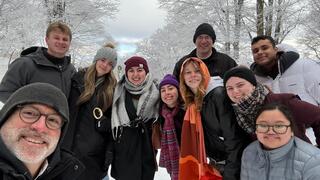 Students and professors atop a mountain in Germany’s Black Forest.
A group of philosophy students from Saint Joseph’s University headed to Germany over winter break to examine different methods of sustainable living.
The trip was the culmination of a semester’s worth of philosophical discussions in PHL 344: A Good Life with Associate Professor of Philosophy James C. Hebbeler, PhD. Students spent the fall semester reading the work of philosophers, from Plato to Axel Honneth, who deal with questions of morality, freedom and what it means to live a good life.
“We start to think broadly about not just the relationships of people to one another, but between people and the institutions that are involved in their lives and between people and nature,” Hebbeler explains. “The relationship between humans and the environment is so often framed as an instrumental one: We should take care of the environment, or else there won’t be one left for us. We talk about that, but we also talk about thinking of nature as a good in itself.”
The class trip to Germany sees these tenets put into action. The group spent the first leg of the trip in Freiburg, a city in the Black Forest of southwest Germany. There, in addition to some traditional sightseeing, they toured two farms with different agricultural practices and spent a day in Vauban, a district in Freiburg known internationally as a “Green City.”
The area was a headquarters for French troops from World War II to the end of the Cold War. When these troops left, the city government created a sustainable community featuring minimal motor vehicles, green spaces and passive houses, or homes that create as much energy as they consume.
“The city government could have sold the land to a developer, but instead, they got together with citizens and building groups and allowed them to design the neighborhood to meet the needs that were most important to them,” Hebbeler explains. “It’s a model for how institutions can reflect the values of the people rather than profit being the driving force.”
This really showed me that there are other alternatives and sustainable ways of living that are feasible and are still good lives.
Nicole Bowen, BS ’26
Students were encouraged to consider ways of life that differed from social and political norms of the United States.
“In the U.S, it’s made to seem like living in harmony with nature and living sustainably is impossible, but it’s not like that in other cultures or in other countries,” says Nicole Bowen, BS ’26, who attended the trip. “This really showed me that there are other alternatives and sustainable ways of living that are feasible and are still good lives.”
The trip also included stops in Tübingen and Frankfurt where they toured additional sustainable infrastructure.
“So much of the course and the trip was geared toward thinking creatively about environmental problems and pressing issues like climate change, fuel use and heating and cooling,” says Joseph A. Corabi, PhD, the chair of the philosophy department who led the trip alongside Hebbeler. “It aligns with our Laudato Si’ initiative and it expands their horizons to see what other possibilities are out there for our future.”