
Person-First: More than a Band-Aid
The following is a reflection penned by Peter Clark, S.J., BA '75, Saint Joseph’s John McShain chair in ethics, professor of medical ethics and director of the University’s Institute of Clinical Bioethics, on his experience at the University's BIPOC Health Promoter Clinic at Mother of Mercy House.
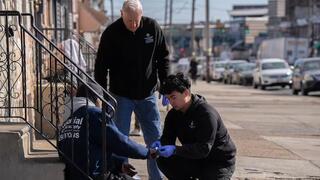
Last night, I had a chance to reflect on what we experienced during our Mobile Wound Care Clinic. Oftentimes, people will say to me, “Aren’t you just putting Band-Aids on the individuals in Kensington suffering from the opioid crisis?”
I have to admit that, sometimes, I even wonder if this is the case when I look at the magnitude of the opioid crisis. That is, until yesterday.
We do not put Band-Aids on the opioid crisis. Yesterday, the ICB Mobile Wound Care Team helped save a young man’s life. His name was Jose. That is not a Band-Aid.
Peter Clark, S.J., BA ‘75
Saint Joseph’s John McShain Chair in Ethics, Professor of Medical Ethics, and Director of the University’s Institute of Clinical BioethicsThe Mobile Team was under the subway tracks caring for our outdoor neighbors. One team was working with a man who had lost all of his toes because of diabetes. A second team was helping clean up a woman who had fallen and had bruises covering her face and neck.
Ean, Carol and Josh — our third team of fellows — were simply observing, until we noticed a young man lying on the steps with two police officers nearby on bicycles. When we approached him, the officers told us that they had administered Narcan and called 911, but, soon after, they pedaled away, leaving him lying there.
His girlfriend was with him, and Ean asked her his name. His name was Jose. He looked to be about 23 years old. From his appearance, it was clear that he was in serious crisis.
Immediately, our team began to administer care for him. Ean was having difficulty finding his extremely weak pulse. Carol could only feel a very weak carotid pulse. We suspected that he had overdosed on medetomidine. At that moment, we looked at one another, as a team, and decided to administer a second dose of Narcan.
Josh administered the second dose of naloxone. Carol held Jose’s head in her lap while Ean performed an aggressive sternal rub. We debated whether we should begin CPR.
Although his color remained an ashen gray, his pulse gradually grew stronger and, after about 15 minutes, EMS finally arrived and rushed him into the ambulance and off to the hospital.
After this incident, the three teams continued walking across Allegheny Avenue and caring for our outdoor neighbors on the other side of the street. Nothing was said about what had just happened. The teams had done their job, and they immediately focused on helping others in need.
Later that day, I found out that Jose had survived and had been admitted to the hospital.
Last evening, I sat in the chapel and realized something very clearly:
We do not put Band-Aids on the opioid crisis.
Yesterday, the ICB Mobile Wound Care Team helped save a young man’s life.
His name was Jose.
That is not a Band-Aid.
That is treating our most vulnerable sisters and brothers with dignity, compassion and respect.
It is meeting people where they are and refusing to walk away when they are in their greatest moment of need.
Thank you to our Mobile Wound Care Team: Dan, Joe, Ean, Josh, Nathan, James, Robert, Amaury and Carol for being there.
Yesterday, you reminded me once again why we do wound care in Kensington.
Father Clark