Prevention Week, Day 1: The Social Norms Approach to Prevention
By: David Sherrell
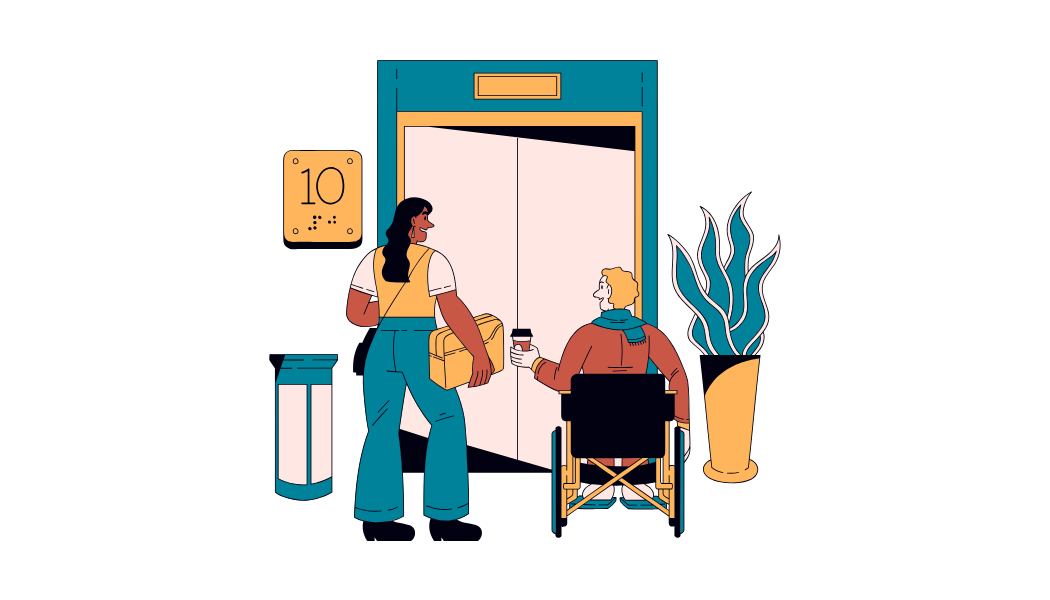
Quick: picture yourself in an elevator. Which way are you facing?
Now imagine yourself preparing to drive your car. Did you buckle up?
You approach a stranger on the street to ask for directions. How far away do you stand?
You greet an old friend warmly, then slip into your usual banter. Are you standing closer together or farther apart than you were with the stranger?
Three more questions before I introduce myself and start this shebang:
Do you think the answers you came up with are universal, pretty common, pretty rare, or totally unique?
Revisit the elevator in your mind. You enter, make brief eye contact with those entering with you or already in, then you see it – someone is standing in the corner – facing the corner. How do you react? What do you expect others to do? Me, I’d hop right off that elevator. I’ll come back around to why in tomorrow’s piece. But first:

On a College Campus in the Eighties
Greetings grown-ups, and welcome to Prevention Week! For those of you new to the EmpowerED Resource Library, my name is David Sherrell; EmpowerED is your go-to space for reliable and recently vetted information about substance use, its prevention, and relevant issues, and I’m the Editor-in-Chief. For those of you returning, welcome back! Either way, come on in and “set a spell,” as my great-uncle used to say, because Prevention Week is the perfect opportunity for me to have a series of quick chats with you, that will sum up to a bit of a deep dive into a theoretical model undergirding anything that can confidently be described as effective youth substance misuse prevention: the Social Norms Approach (SNA).
The Social Norms Approach was developed in 1986 at Hobart & William Smith Colleges (HWS), in upstate New York. They had undertaken a school-wide survey to measure its alcohol and other drug use, among other risky behaviors. Counselors and researchers wanted the data because they were planning to develop interventions meant to reduce what they perceived to be a high-risk environment of pervasive substance abuse; they saw frequent and severe negative consequences affecting student wellbeing. DARE – considered at the time to be an exemplar of schools-based prevention – was in its infancy. A decade on, research would reveal its ineffectiveness, one cause of which was that they launched without exactly the sort of preparatory research done at HWS. The idea that one should comprehend the precise size and scope of the problem before beginning to address it was, in itself, somewhat novel in the field at the time.
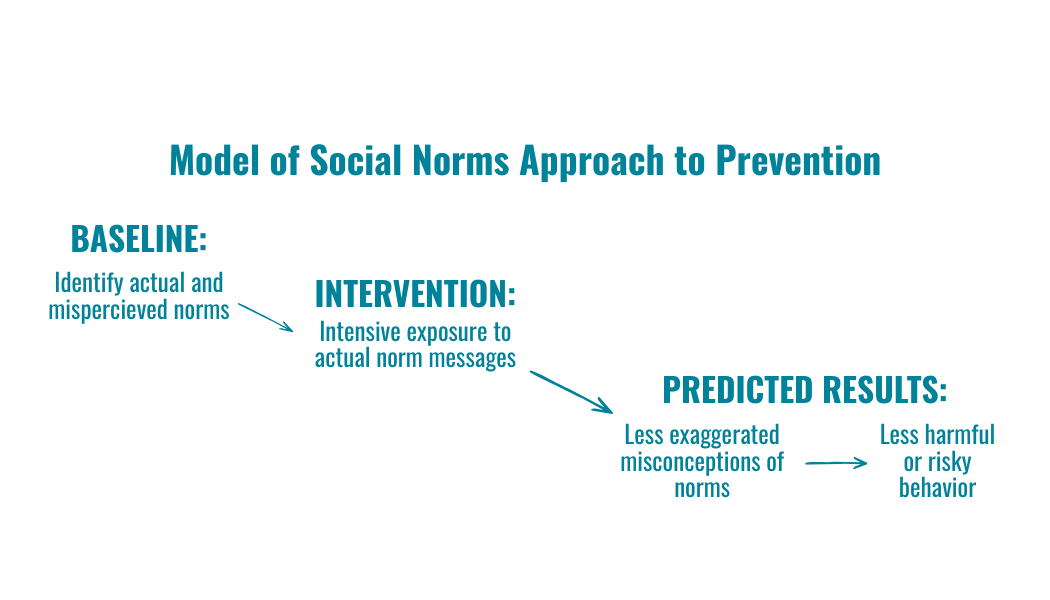
When Hobart & William Smith staff examined the data they had collected – after correcting for any potential anomalies that might significantly impact results – they were surprised. There was a substantial gap between the actual norms relative to substance use on campus and what they – and the students – perceived those norms to be. This is a finding repeated consistently over many years, across many universities and down into secondary and middle schools: people, both adults and youth, overestimate the prevalence of risky behaviors in their environment and underestimate the prevalence of healthful behaviors in their environment. Effective substance abuse prevention may take any number of different shapes depending on the programming, but one objective knowledgeable Prevention Specialists will always pursue is the correction of these misperceived norms. Not only does dispelling the myth that “everybody does it” relieve a great deal of pressure to initiate a risky behavior; closing the gap between perception and reality also encourages those who thought their behavior was completely normative (in keeping with what is both normal and appropriate) to reevaluate their decisions in a new, healthier context. And those are just the top two items on a longer list of ways intervening on these misperceptions promotes community health.
More simply put, and as I hope to have demonstrated with my thought exercises: people tend to do what they think is normal. Convince them that – for example – higher-risk alcohol use in college is, statistically, not normal, and they are less likely to do it.
The researchers at HWS began sharing their data around campus. They posted a variety statistics on campus billboards and in the school newspaper describing the true scope of alcohol use on campus: how many students drank how much alcohol how often, among other information. After allowing time for this intervention to take effect, they reassessed the community, predicting an improvement in community health. Ultimately, once this perceptual intervention was bound to educational and relevant social-skills-building sessions, their intervention indeed proved effective [1].
Do We Know How It Works?
I can think of no better way to kick off a week dedicated to the celebration and promotion of prevention than by sharing this final truth with you: the consistency with which the pattern of overestimation I mentioned earlier shows up and the consistency with which research shows that reducing those overestimations improves health in a given community comprise one of the most unassailably repeated findings in social science. Why? How?
I’ll tell you tomorrow. It’s all to do with that elevator example.
Sources:
[1] Perkins HW. The social norms approach to preventing school and college age substance abuse: A handbook for educators, counselors, and clinicians. John Wiley & Sons; 2003.