Prevention Week Day 4
By: David Sherrell

Welcome, everyone, to the final day of Prevention Week! I have very much enjoyed the process of writing these short pieces for you; the social norms approach can be a difficult thing to unpack in a way that both communicates its intricacies and respects everybody's time. I could write without end about social norms without repeating myself; by keeping it to two pages per topic and spreading it out across a week meant to raise awareness, I'm able to give you both concise summaries of public health information and enough information about social norms that you can use this approach in your own conversations with your youth. Because while effective substance misuse prevention may be a thing organizations like Prevention Academy concern themselves with, that doesn’t mean they’re the only agents of prevention. In fact, everyone has a role, including the students themselves. Let’s look at how SNA impacts communities.
How the Social Norms Approach Looks & Works in Action
Multiple Mechanisms = Cumulative Impact
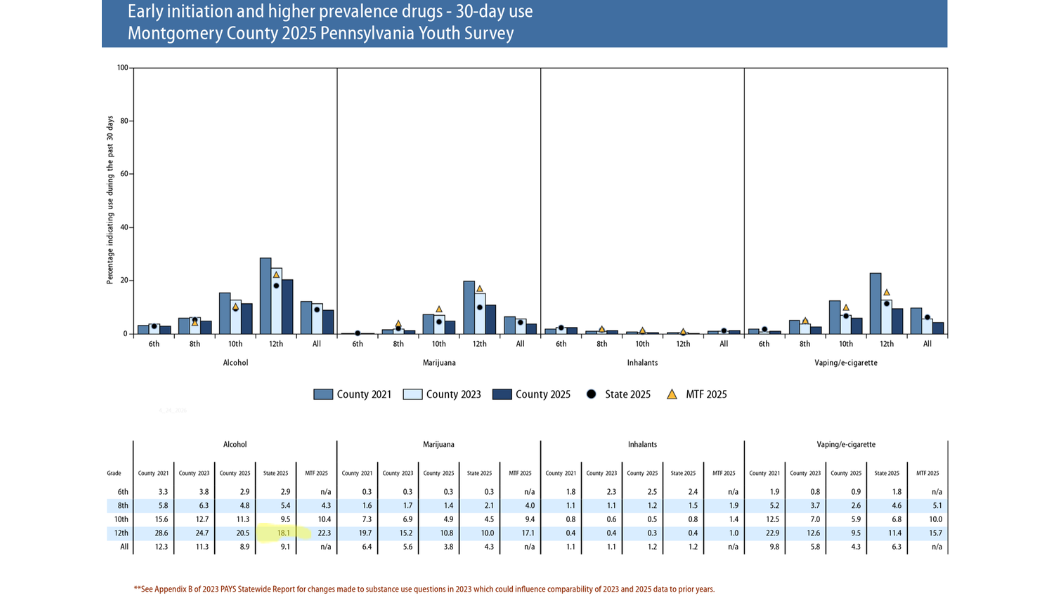
If you clicked on one of yesterday’s links, to Monitoring the Future (MTF) or the Pennsylvania Youth Survey (PAYS), you’d have seen a wealth of data related to substance use – when you’re seeing something like, 18.1% of PA 12th graders report drinking alcohol in the past 30 days, that’s a single indicator of community well-being, and exactly the kind of reality it can be difficult – and all the more important – to convince people of, if they have long assumed most high school seniors are engaged in risky behavior more often than that. Using the social norms approach can mean displaying a complex graph and table like the above to a room of school staff, or parents, and discussing several different trends in community health – and hey, it’s all good news, Montgomery County, although we still need to talk about vaping – or I can take the single highlighted statistic into each of my classrooms, and here are just a few outcomes (among many other possibilities) I expect based on years of research into why SNA works and my own 17 years working in prevention classrooms around the world:
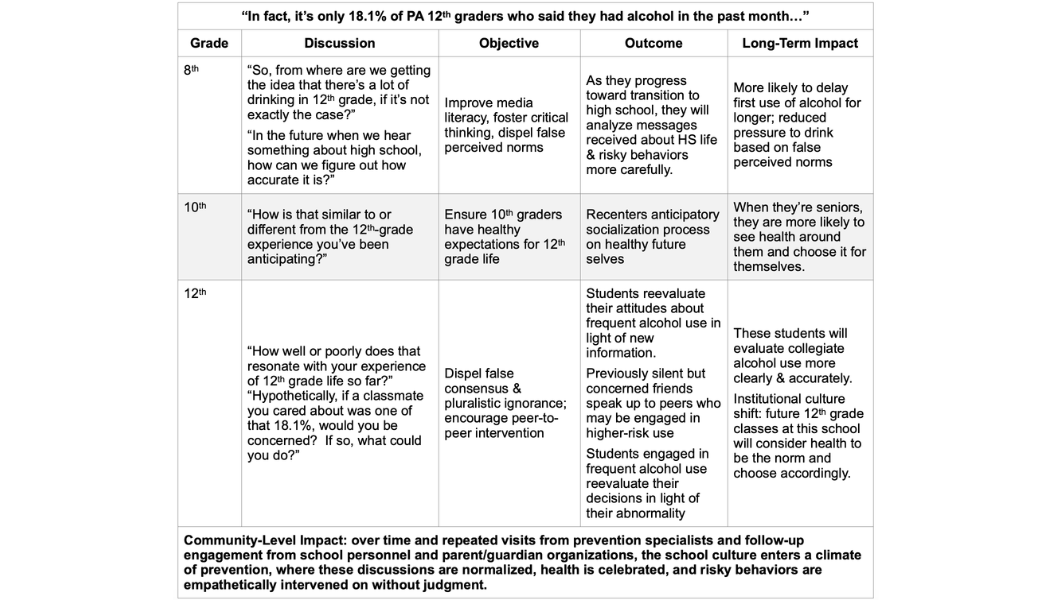
When the communities we engage with are receptive to the discussions we host and the information we share, we can generate these outcomes and more with one statistic; imagine what we could do with an extensive report full of them. But it’s not our job alone.

In-School and At-Home Prevention Using the Social Norms Approach
Try Not to Deal In Absolutes
One simple, yet challenging thing all adults can do to foster the climate of prevention mentioned in the above table is to monitor how they talk about alcohol and other drug use. Word choice matters a great deal: the more you monitor yourself and reduce or eliminate absolute terms like “everybody” and “nobody” when discussing healthy or risky behaviors, the more your students will understand that we’re talking about a complex reality. “All your friends are going to want to,” “Everybody in college tries it at least once,” and other similar phrases close doors to fascinating discussions that could help your youth understand the actual realities in question much better. And since these discussions will foster critical thinking, encourage them to perform careful research on the Internet, and start intentionally shaping their Ideal Future Selves, there are a whole host of brain-development related benefits to be had from the simple choice to avoid simplistic language.
Keep Health At the Center
Prevention Specialists speak of substance use in a values-neutral manner, not because it’s always a values-neutral behavior, but because we don’t want to step on the toes of the parents, guardians, mentors, teachers, and others whose role is to help them understand and shape the values they will live by. But even though the discussions you have with your youth should include establishing relevant values – “At this school, we take care of each other,” “In this house, we believe there are religious/spiritual reasons not to make these risky decisions” – it is still important to keep their mental and physical wellbeing – in the present and for the future – at the center of your discussions. Their health is the first thing jeopardized by these risky situations; it is compromised health that paves the way for further negative consequences. This ensures that they never lose sight of the stakes attached to their choices.

Challenge Your Own Assumptions
Misperception is the fuel that drives the engine of risky decision-making among adolescents – but it’s not only their misperceptions clouding their ability to make norms-accurate, prosocial and identity-consistent choices that move them closer to their Ideal Future Selves. You, as the adults in their lives, still have immense power to shape their understandings of their environment in sweeping and nuanced ways with the most casually uttered of mistaken impressions. “That drug is everywhere” and “You teenagers think you’re invincible,” are examples off the top of my head that teach your kids something about how you perceive the world relative to adolescent substance misuse and other risky behaviors. They will, consciously or subconsciously, reevaluate their own perspectives in light of these statements – don’t let them internalize your misperceptions. I highly encourage taking a look at the Pennsylvania Youth Survey in particular, as a great many healthy norms are revealed.

Network
Check in with each other, parents and guardians especially – confirm with each other that you’re all, despite what pluralistic ignorance may tell you, striving to set healthy and appropriate boundaries for your kids.
Be Teachable
Be a little willing to be a little wrong in some of these areas – if you let an absolute term slip through, or catch yourself condemning the entire generation because you just saw a story about a particularly absurdly risky decision a group of teens made, that’s okay. It’s all about progressing, ensuring our understandings of the world of adolescent risk and health have been updated recently, and ensuring that we’re passing on what we have learned to the kids who still have some very consequential decisions ahead that will benefit from our wisdom.

Thanks – And Don’t Hesitate to Reach Out to Us
Thank you so much for spending Prevention Week with us! It’s a personal and professional mission of mine to seed the social norms approach throughout the whole population of adults who care for kids – at home and at school – and you now hold more knowledge about it than many of your peers. Share it around!
If you have any questions about anything you’ve read, if you want to know more about prevention in general or Prevention Academy in particular, please don’t hesitate to contact us! We are eager to serve.