As Philly Heats Up, One Recent Graduate Looks to the Trees
Recent alumna Nicole Bowen, BS ’26, wrote her honors thesis on carbon storage of trees and green spaces on Hawk Hill.
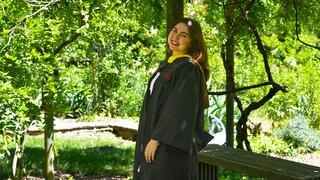
Nicole Bowen, BS ’26, has been passionate about environmental science and climate solutions since high school.
As an environmental science major with minors in English and philosophy at Saint Joseph’s University, Bowen sought to learn about and find ways to contribute to climate research. Not only did the recent graduate serve as co-president of the University’s Green Fund, but she also devoted her honors thesis project to the study of the tree canopy and green spaces on Hawk Hill.
Specifically, Bowen quantified carbon stocks in living trees and soils on campus.
“I wanted to do something hands on, especially with sustainability and climate change,” she says. “I went out in the field and did some hands-on work with tree surveys and soil sampling. It really fit in with what I was interested in.”
In addition to carbon storage, trees and green spaces affect temperature outdoors and even inside buildings. And Philadelphia is experiencing more extreme heat events due to climate change.
The average temperatures in the city have increased by nearly 4 degrees Fahrenheit since 1970, and by 2080, average temperatures could increase by 5 to 8 degrees, according to the city’s extreme heat guide.
Extreme heat harms people’s health, causing dehydration and heat stroke and worsening existing conditions such as cardiovascular and respiratory diseases. Heat impacts vary by neighborhood; those with fewer trees and green spaces tend to be hotter than surrounding areas, because buildings, roads and hard surfaces absorb and retain heat. Areas with less tree cover tend to be underresourced, the city notes.
Philadelphia Parks & Recreation is working in partnership with the Fairmount Park Conservancy on a tree planting initiative called TreePhilly, which is striving to reach 30% tree canopy coverage in every Philadelphia neighborhood.
The average temperatures in the city have increased by nearly 4 degrees Fahrenheit since 1970, and by 2080, average temperatures could increase by 5 to 8 degrees, according to the city’s extreme heat guide.
Bowen’s research is the means to a similar end at Saint Joseph’s, according to her faculty mentor, Clint Springer, PhD, professor of biology and director of the Institute for Environmental Stewardship, and director of the Barnes Arboretum at Saint Joseph's University. Bowen’s thesis, which includes a geographic information system (GIS) map of the tree canopy and carbon storage capacity of greenery on campus, serves as a baseline measurement that can help leaders work toward sustainability goals outlined in The President’s Laudato Si’ Sustainability Initiative.
“You can't manage what you don't measure, so that's really what we're doing here is getting the first set of measurements done, and then also looking for any interesting patterns that we observed,” Springer says. “What we have from Nicole's thesis is a really strong modeled estimate of carbon storage.”
The 12-acre Barnes Arboretum is, unsurprisingly, the largest carbon sink on campus. Across the entire main campus, 1,937 inventoried trees store roughly 1,938 tons of carbon, according to Bowen’s research. Based on the average person’s annual carbon footprint in the U.S., trees on campus store carbon emissions of roughly 403 students.
“It’s important work,” Springer says of Bowen’s research. “It’s not just an academic exercise here. We’re going to use it.”
Bowen also found that rain gardens and native pollinator gardens, which benefit crucial pollinators such as bees and butterflies, help soil better store carbon than just grass lawn does.
“St. Joe’s has these already, so just having more areas for native plants is really beneficial for butterflies and bees, and they’re just so much better for the soil,” she says.
Both Bowen and Springer say that they hope Bowen’s research leads to more tree planting on campus, particularly trees native to Pennsylvania, to help offset the University’s carbon emissions and provide other cooling benefits. Native tree species in the region include oak, hickory and tulip trees.
Already, the University has more than 375 trees on campus after the construction of Sister Thea Bowman Hall and Kelly Plaza, with more plantings planned in the future.
“I feel like the benefit from trees – the shade and subsequent cooling – sometimes goes unnoticed, but it’s so, so important,” Bowen says. “It’s very important to maintain the landscape and the biodiversity and ecosystem that already exists at St. Joe's.”