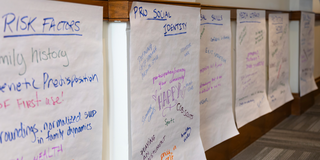
Risk: Friend or Foe? Time to Talk to Kids About “Risk”
By: Juliette Louer, B.S.P.H.
September is a time of transition. It represents the culmination of summer and the dawn of a new school year. As your child enters a new grade, there are going to be changes in their life, and changes are a great opportunity in supporting your child. These changes can include trying out for a new sport or activity, taking more challenging classes, preparing to apply to college, trade school, and other transitions, and reacquainting or meeting new friends. All of these new decisions can feel like taking a risk, but as we’ll discuss, risk is not always negative.
As humans, we take risks everyday. Maybe we wear our hair differently one day, sit next to someone new the next, or take a new route to school. The assumption when we hear the word “risk”, can be that something negative is going to happen. We hear things from countless sources and may even warn our children about the things we’re hearing, like the risk of crossing the street without looking, stranger danger, and the risk of skipping school. As kids grow and thrive, we identify age-appropriate risk, such as the risk of using substances, drinking and driving, and engaging in high-risk behaviors. And yes, these are all real risks and important to discuss with our children. But that’s not all risk is. Risk is the likelihood or chance that something will happen, and can be either positive or negative, and healthy or unhealthy. Risks are intrinsically part of the growing experience, and are essential for our development as people. Risk pushes us out of our comfort zones, leading to our formation as thriving human beings, while also offering the development of resilience.
You may have noticed my use of healthy vs unhealthy, not the use of good or bad. When we use words like good and bad, and right and wrong, it adds a layer of judgement or stigma on people’s choices and adolescents are particularly sensitive to the feeling of being judged. When we use healthy or unhealthy, we’re talking about the actual choice itself, not the person making decisions. We’re all human, we make choices everyday. Those choices are not always indicative of who we are as people. Removing the labels of “good” and “bad” can allow for improved communication between kids and adults, as it removes the judgement behind these choices.
In recent years, within the disciplines of science and medicine, we’ve come to understand that the human brain is an incredibly complex organ. It regulates just about everything human beings do. The brain’s development continues through childhood, adolescence, and well into early adulthood, achieving relative maturity by age 25 [1]. You’ve also likely heard that it is responsible for critical thinking, (prefrontal cortex), which is activated when determining if we’re making healthy or unhealthy choices. Now, our brain’s not a mind reader (as ironic as that sounds), so how can our brain tell if something is healthy or unhealthy? First, our brain can run through possible consequences or scenarios regarding the choices we make. Second, our brain can use past experiences to figure out what’s healthy vs unhealthy. All in all, we need our brain to think through difficult and new experiences, to help us place what our intuition is trying to say.

Every data piece that Prevention Academy brings to the classroom and our school communities (Pennsylvania Youth Survey, Monitoring the Future), illuminates the unwavering upward trend of healthy choices made by youth. Therefore, talking works. Even so, this doesn’t mean support stops or that our work is done, but is actually when our role as trusted adults is most crucial. Remember parents, there isn’t much of a difference between the feelings associated with healthy vs unhealthy choices. Both can feel exciting and thrilling, but also scary and intimidating, which can be confusing. Growth itself can be uncomfortable and daunting, but is a necessary part of adolescence and life. And sometimes, whether they want it or not, children often need guidance and encouragement through making healthy, informed decisions.
With the start of the new school year, it’s important to be on the same page as your kids, and to continue to support, uplift, and enlighten them on the impact risk has on their future. Have tough conversations, be open and honest, and continue to unpack what health and wellness means to you and your family, including how risk impacts your lives. Choice is a significant part of life and makes us who we are, but we must take charge and actively choose healthy risks, to further the amazing phenomenon that is today’s children evolving into tomorrow’s thriving adults.
Parent resources about risk-taking behaviors:
Center for Health and Safety Culture. Healthy Risk Taking. https://toolsforyourchildssuccess.org.
CHOP’s Center for Parent & Teen Communication: What are healthy risks?
Want to take a look at the data?
Pennsylvania Youth Survey 2025 (Pennsylvania, Delaware County, Montgomery County)
Sources:
1. Romer D, Reyna VF, Satterthwaite TD. Beyond stereotypes of adolescent risk taking: placing the adolescent brain in developmental context. Development Cognitive Neuroscience. 2017:27(1):19-34. doi:10.1016/j.dcn.2017.07.007
2. Caruso C. How does the brain make decisions? Harvard Medical School. https://hms.harvard.edu/news/how-does-brain-make-decisions. Published Feb. 21, 2024