A Voice for the Future of Pharmacy: Laura Waite, PharmD, Elected National Leader
The clinical professor of pharmacy practice has been elected to serve as the speaker of the House of Delegates of the American Association of Colleges of Pharmacy.
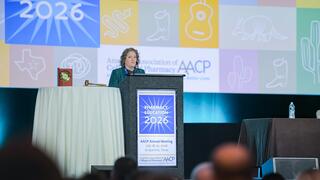 Waite at the American Association of Colleges of Pharmacy's annual meeting in July
Beginning in July 2027, Saint Joseph’s University’s Laura Waite, PharmD, BCPS, CLS, will serve as speaker of the House of Delegates for the American Association of Colleges of Pharmacy (AACP), bringing her experience in higher education, clinical practice and student advocacy to the national role. The Linwood F. Tice Clinical Professor of Pharmacy Practice in the University’s Philadelphia College of Pharmacy will serve a three-year term, overseeing the association’s operations and ensuring business is conducted fairly.
“We have so much to look forward to as an organization, and I believe strongly in the crucial role of the House of Delegates and member voices in shaping our future,” says Waite, who also serves as associate dean of student affairs and admissions for the School of Health Professions.
The AACP is a national organization that works to advance pharmacy education, research, scholarship, practice and service, to improve health for all.
SJU News spoke with Waite about her appointment and role in shaping the future of pharmacy education.
Can you talk about AACP’s mission and how the speaker of the House supports this charge?
AACP’s goal is to advance academic pharmacy: teaching students to be able to practice at the top of their pharmacist license; maintaining appropriate educational standards; moving the profession forward by being innovative in our teaching approaches; and connecting our students with pharmacists who are practicing in innovative settings.
The House of Delegates translates the perspectives of its 142 member institutions into policy. As speaker, I lead that effort and run our house sessions, working with the Bylaws and Policy Development Committee and the delegates to address new business and maintain house procedures. The results go to the board of directors for implementation.
What are some of the challenges facing pharmacy education today, and what is AACP’s role in addressing these challenges?
Most people think of a pharmacist in a community-pharmacy setting, and while that is a fantastic career option, less than half of practicing pharmacists are doing that. That's a great thing for our students; there are so many things you can do with a pharmacy degree. What that can result in, though, is a somewhat fractured profession. It’s been difficult for us to unify and say, “Everybody needs to get behind X, Y and Z.” AACP has tried to champion all of those career opportunities without allowing them to compete with each other. That can be reflected in our educational approaches, in the way that we structure our faculty bodies, and in the messages we give to students.
There’s also a lot in the news about changes in vaccines — it's a huge part of what pharmacists do — so we need to prepare our students for what comes next. We've partnered with other healthcare professional organizations on statements about what is fact- and evidence-based, because it’s the right thing to do.
Similarly, professional programs in higher education have been changing, and we’ve partnered with professional organizations there as well — to state our position and navigate things like financial aid and the logistics of being a healthcare provider.
The dispensing model — getting medication to patients — is becoming more automated. But, the brain power behind that, in terms of is this the most appropriate and safest option — that’s the kind of thing that can’t be replaced by AI or automation.
Laura Waite, PharmD, BCPS, CLS
What are you most excited about as you become House speaker?
The organization is looking at restructuring our governance. We've hired a consultant whose recommendations will be implemented when I'm transitioning from speaker-elect to full speaker. Much of the work is going to require bylaw and rule changes around the way our organization is set up and how we represent opinions. Helping to make sure everyone's voices are heard in that process is rewarding.
How is the role of the pharmacist changing, and how should pharmacy education change with it?
We've been working for a long time toward establishing an identity as a patient care provider. We're not here to say, “Here are 10 over-the-counter pain medications, buy the one that you prefer.” We're here to talk about why medication is important to address their concerns, why this particular medication might be dangerous for them, and where the evidence shows that certain things matter and certain things don't. Moving the pharmacy profession toward the application of direct patient care principles is one of the things that I think is evolving in the profession.
Concurrently, the dispensing model — getting medication to patients — is becoming more automated. But, the brain power behind that, in terms of is this the most appropriate and safest option — that’s the kind of thing that can’t be replaced by AI or automation.
At the same time, we’re seeing a lot of roles that aren’t patient facing. Those drug commercials you see with all of the fine print? Pharmacists are a part of that. As educators, we have to be familiar with these opportunities, discuss best practices, and be able to position our students when these newer roles come along.
What does your election say about the reputation of Saint Joseph’s and the Philadelphia College of Pharmacy?
Being in this role means all 142 pharmacy schools hearing “Philadelphia College of Pharmacy at Saint Joseph's University,”' which puts the Saint Joseph's name in pharmacy circles where it hadn't been before. And PCP has been at the table in this profession for generations, so there's a real baseline of credibility — an expectation that people from PCP are here to move things forward.
What are your hopes for the next generation of pharmacists?
I hope that someday they understand what an important contribution they are making to society by choosing this profession. It doesn't always feel that way when there are 25 customers in the drive-through line, or when you're busy with metrics or filling IV meds. But you're making a difference every single day in somebody's life — either directly or indirectly. You matter.