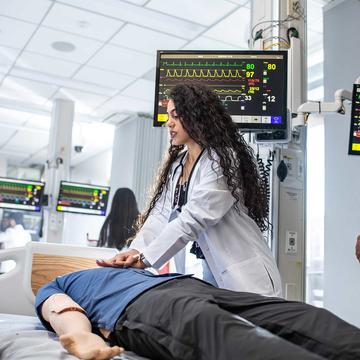
Master of Physician Assistant Studies (MSPAS)
Saint Joseph’s University’s Master of Science in Physician Assistant Studies (MSPAS) 24-month program prepares you to deliver a broad range of medical services as a physician assistant, including primary care, research and education.
You’ll become a leader and innovator in this fast-growing and rewarding medical profession through Saint Joseph’s physician assistant graduate program. You’ll learn how to take medical history, administer exams, evaluate lab tests and provide health counseling. You’ll also work with patients of all ages in the Greater Philadelphia area and neighboring states through 45 weeks of nine clinical rotations, under the supervision of a physician or a licensed PA, putting your knowledge into practice.
Please visit Saint Joseph's Physician Assistant Academic Department website for the complete information required by the Accreditation Review Commission on Education for the Physician Assistant (ARC-PA).
What Sets Our Program Apart
-
You’ll obtain detailed anatomy instruction through the Touch of Life Technologies VH Dissector platform on Anatomy Toltech tables. This technology provides innovative and adaptive high-resolution virtual views for learning both in the lab and at home on desktops/laptops. This platform also allows for the incorporation of anatomical concepts with real-world clinical applications, which is useful in understanding radiology, surgical procedures and other important areas of clinical medicine.
-
All PA students complete nine clinical rotations: two family medicine rotations, emergency medicine, pediatrics, internal medicine, surgery, women’s health, behavioral health and an elective.
-
Our experienced faculty collectively have 25+ years of physician assistant education teaching experience and 60+ years of clinical experience, with support from additional University scientists and clinicians who are renowned in their fields.
-
You’ll be given individualized advisement and learning resources at the programmatic and University levels to ensure successful degree completion and preparation to sit for the NCCPA national certifying exam, so you can take your place as an outstanding health care provider in all fields of medicine.
-
At its March 2025 meeting, the Accreditation Review Commission on Education for the Physician Assistant, Inc. (ARC-PA) placed the St. Joseph’s University Physician Assistant Program sponsored by St. Joseph’s University on Accreditation-Probation status until its next review in March 2027.
Probation accreditation is a temporary accreditation status initially of not less than two years. However, that period may be extended by the ARC-PA for up to an additional two years if the ARC-PA finds that the program is making substantial progress toward meeting all applicable standards but requires additional time to come into full compliance. Probation accreditation status is granted, at the sole discretion of the ARC-PA, when a program holding an accreditation status of Accreditation - Provisional or Accreditation - Continued does not, in the judgment of the ARC-PA, meet the Standards or when the capability of the program to provide an acceptable educational experience for its students is threatened.
Once placed on probation, a program that fails to comply with accreditation requirements in a timely manner, as specified by the ARC-PA, may be scheduled for a focused site visit and is subject to having its accreditation withdrawn.
Specific questions regarding the Program and its plans should be directed to the Program Director and/or the appropriate institutional official(s).
The program’s accreditation history can be viewed on the ARC-PA website at: https://www.arc-pa.org/accreditation-history-saint-josephs-university.
What Can You Do with an MSPAS Degree?
Physician assistants continue to be an in-demand specialty in the healthcare field. In fact, physician assistants ranked no. 2 on the list of best jobs to have in the United States. Additionally, employment prospects for PAs are projected to grow 31% from 2020 to 2030 — much faster than the average 8% for all occupations.
With a PA degree, you can work as a physician assistant in a number of diverse environments, including:
- Hospitals
- Community health centers
- Doctors’ offices
- Outpatient care centers
Physician assistants also work in federal or state government institutions and in colleges and schools.
Why Study Physician Assistant Studies in Philadelphia?
Most clinical rotations at Saint Joseph’s are offered in the greater Philadelphia region, home to multiple world-class, U.S. News and World Report–ranked hospitals and doctors, with opportunities to build local and regional health care networking and employment after graduation.
Partnering with our pharmacy, occupational therapy and physical therapy programs as well as with medical schools, social work programs, nursing schools and communities in Philadelphia also allows for unique interprofessional learning experiences (IPE) and provides a competitive edge in the thriving health care sector.
Physician Assistant Admissions Information
The Saint Joseph’s University Admissions Committee will be accepting applications through the Centralized Application Service for Physician Assistants (CASPA) from April to October each year for the class matriculating in the subsequent year. Admission to the program is on a rolling basis and so applying early is suggested. For complete admission information, please visit the Physician Assistant Academic Department website.
Program Details
For complete information regarding mission and goals, policies, accreditation, admission information, cost of attendance, curriculum information, licensure and disclosures and more, please visit the Department of Physician Assistant website.
Frequently Asked Questions (FAQs)
-
To become a physician assistant (PA), you’ll need to:
- Earn a bachelor’s degree. Most PA programs prefer applicants who have a bachelor’s in science or a health-related field.
- Apply and get accepted to a PA school with an accredited PA program, such as Saint Joseph’s 24-month MS in Physician Assistant Studies degree.
- Complete and graduate from an accredited PA program, which involves clinical experiences.
- Pass the Physician Assistant National Certifying Examination (PANCE) to get certified, then obtain a license in the state you want to practice in.
-
If you already have a bachelor’s degree, it takes around three years (26 months) to complete an accredited PA program. At Saint Joseph’s University, you can earn your PA degree in just 24 months. After graduating, you can sit for the PANCE exam and pass it to become certified and take the next steps to obtain a state license.
-
Saint Joseph’s University undergraduate students in the Pre-Professional PA Program are granted an interview for admission to the MSPAS Program if all progression requirements of the Pre-PA program and all admission requirements of the Graduate PA program are met. Students in the accelerated track who meet all requirements may apply to the graduate PA program between the end of their sophomore year and the fall of their junior year, with an application deadline of October. If accepted, they will earn the remaining credits to complete their bachelor’s degree with the completion of the didactic phase of the MSPAS Program. Undergraduate students in the traditional four-year Pre-Professional PA program who meet all progression criteria and all admission requirements of the Graduate PA program are also granted an interview. If granted an interview, this does not guarantee acceptance to the MSPAS Program.
All applicants to the MSPAS Program must apply through the CASPA application portal and follow the same admissions process.
-
According to the Bureau of Labor Statistics, the annual salary of a Physician Assistant in Philadelphia is $140,910.